Since the inauguration on 9th-March, 2001, the Administrative Court of Thailand has adhered to its mission to uphold administrative justice for all in an efficient manner and in conformity with relevant international standards. The Administrative Court is always aware of how the quality of administrative justice contributes to formulating a good norm for State administration and maintaining a balance between the rights and liberties of the people and the public interest. To achieve such quality of justice, the Administrative Court continually enhances and strengthens knowledge and expertise among the judges and personnel involved in administrative judicial proceedings. Additionally, to ensure an awareness of individual rights and liberties in all sectors, the Administrative Court disseminates relevant knowledge and enhances better understanding on how administrative judicial proceedings function and how the Administrative Court can protect individual rights and liberties.
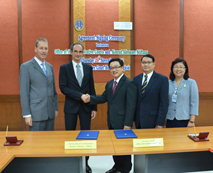
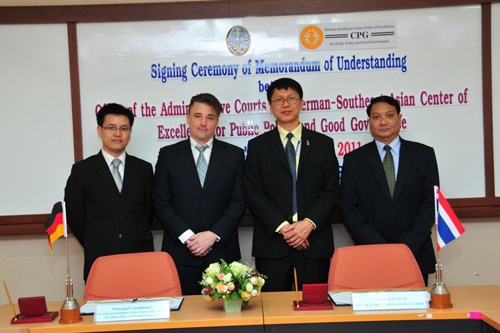
On behalf of the Administrative Court of Thailand, the Office of the Administrative Courts keeps strengthening and extending international cooperation networks. Generating international cooperation is intended to not only improve judicial management and quality of administrative justice, but also to promote the Administrative Court's role as the hub of administrative judicial excellence at the international level.
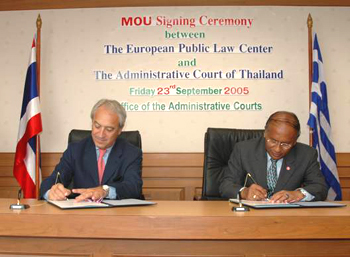
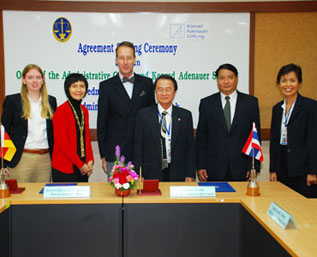
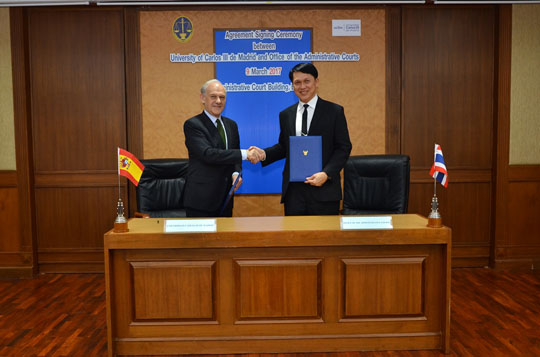
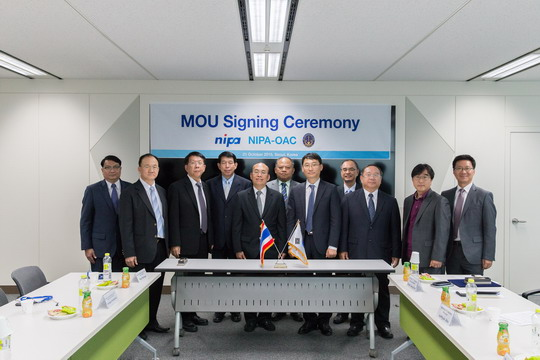
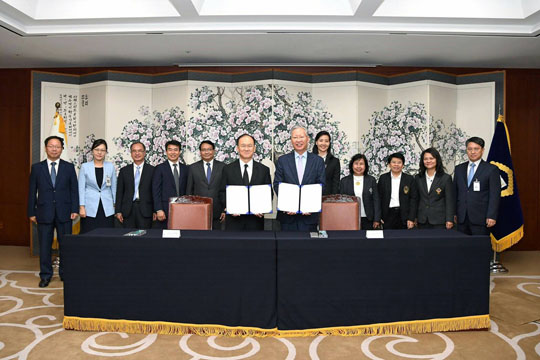
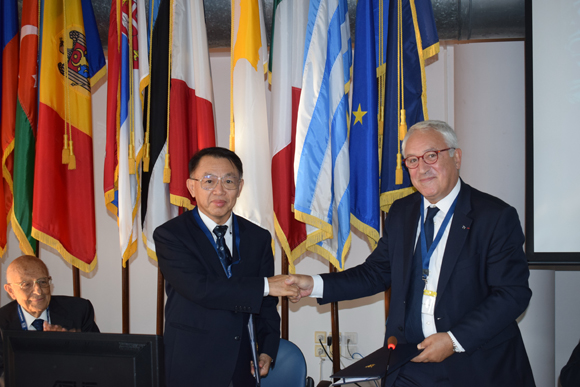
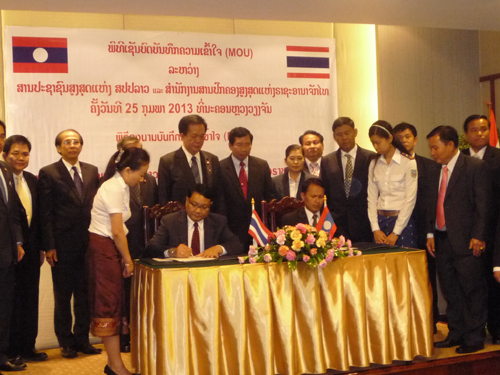
Presently, the Office of the Administrative Courts has entered cooperation agreements and MoUs with the following entities:
- Association of Accounting Technicians and AusAID
- Canadian International Development Agency (CIDA)
- European Public Law Organization (EPLO)
- Federal Court of Australia
- German-Southeast Asian Center of Excellence for Public Policy and Good Governance (CPG)
- Government of Spain
- Konrad-Adenauer-Stiftung, Thailand (KAS)
- Korean Advanced Institute of Science and Technology (KAIST)
- National IT Industry Promotion Agency (NIPA) of Korean government
- People's Democratic Republic of Lao: the People's Supreme Court of the Lao PDR
- Rule of Law Program Asia, Konrad-Adenauer-Stiftung
- Supreme Court Library of Korea
- The Asia Foundation (TAF)
- United States Agency for International Development (USAID)
- Université Toulouse 1 Sciences Sociales
Major activities carried out by virtue of these cooperation agreements and MoUs include international seminars and conferences; special lectures; sponsorship for study visits and overseas post-graduate studies; foreign expert allocation; publishing of administrative judicial manuals for judges and personnel of the Administrative Court; and production of publications on getting to know the Administrative Court and Administrative Court procedure.
International cooperation enables the Administrative Court of Thailand and partners to mutually develop best practices for the improvement of each party's administrative judicial system. Educational activities based on inter-organization cooperation (e.g. training, researches, and comparative studies) foster the exchange of knowledge, perspectives, and experience useful for the efficient and effective administration of administrative justice. Additionally, the Administrative Court and partners aim to not only enhance knowledge among their judges and personnel, but also to equip the general public and State officials with knowledge on the nature of administrative disputes and the filing of administrative cases.